Guanajuato City Safety for Solo Female Travelers: 7 Tunnels, 4 Hills, and What the SESNSP Data Actually Shows
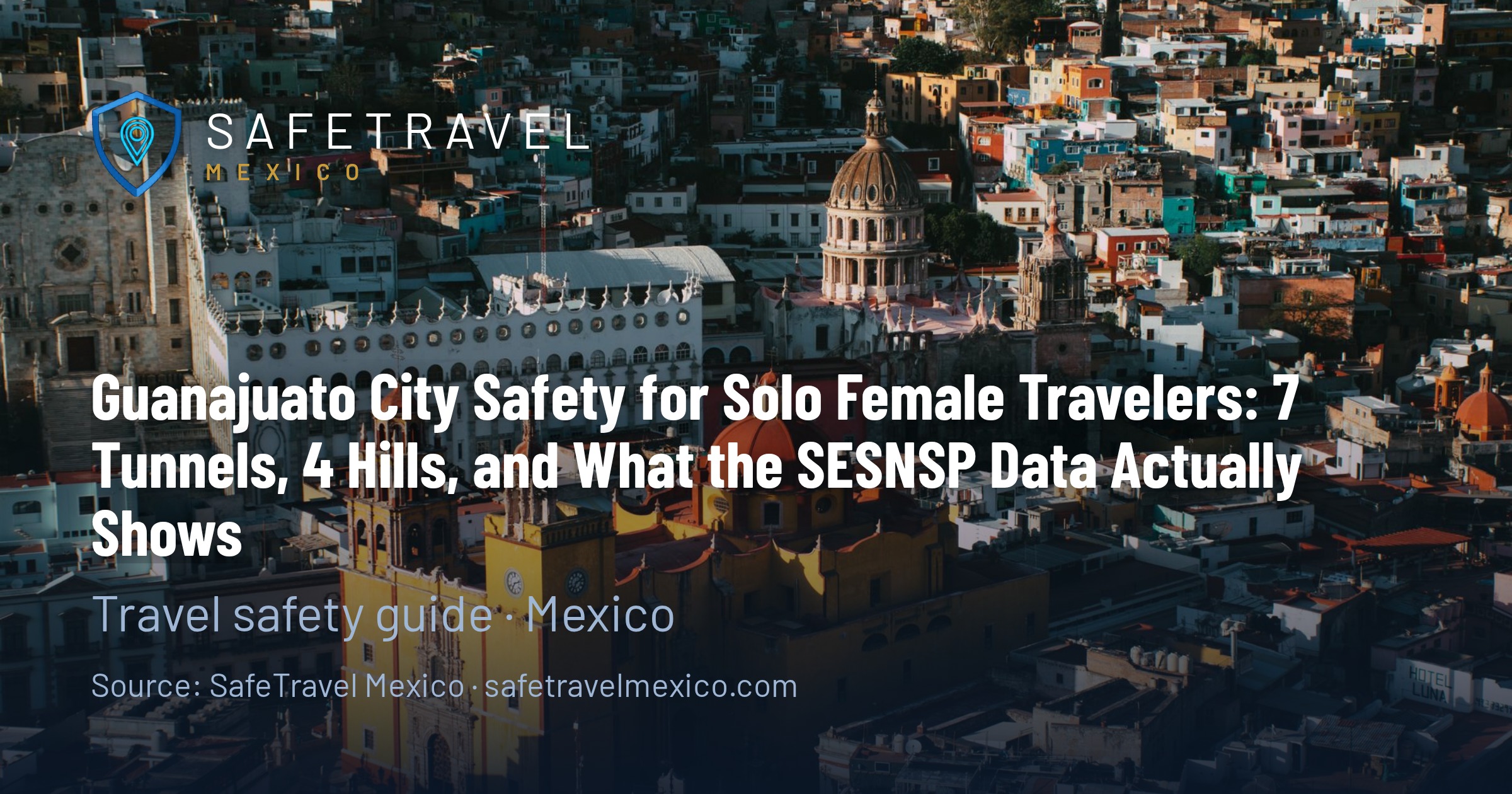
Guanajuato City Safety for Solo Female Travelers: 7 Tunnels, 4 Hills, and What the SESNSP Data Actually Shows
Guanajuato capital sits in a river gorge so steep that cars were banned from the historic center in 1907. The result is the 7 subterranean tunnels that now run underneath the city — some paved, some still rough stone, lit only by the headlights of the buses that use them. Most first-time solo female visitors don't realize, until they're standing in Callejón del Beso at 11 p.m., that the alley above them is not the same street the bus goes through.
That confusion is the point of this guide. The official SESNSP-derived risk score for Guanajuato city is 3.00 / 10 ("elevated") based on the SafeTravel database of 1.5 million Mexican government crime records through 2025 Q4. That's lower than León (Guanajuato state capital metro, 4.10), lower than Irapuato (5.20), and dramatically lower than Celaya (6.40). It's also higher than Mérida (1.80) or Valladolid (1.40) in the Yucatán, the two cities that dominate Mexico's "safest" lists.
In other words, Guanajuato is a mid-pack colonial city where the tourist pocket behaves like a low-risk city and the hillside barrios behave like a high-risk one. Solo female travelers who stay in the former and avoid the latter have a great trip. Solo female travelers who mistake one for the other do not.
This guide breaks down the city's actual risk by neighborhood, the seven tunnels by name and safety profile, and the four hillsides that locals will quietly tell you not to walk up alone after dark.
Why Guanajuato Reads Confusing on Safety Apps
Most travel safety apps treat Guanajuato as a single point on the map. They return a number — usually between "moderate" and "elevated" — without telling you that the city has roughly four distinct micro-climates stacked vertically into the same valley:
- The Centro Histórico (Plaza de la Paz, Jardín de la Unión, Teatro Juárez): pedestrianized since the early 2000s, busy until 11 p.m., heavily policed because of the Universidad de Guanajuato student population.
- The Subterranean Tunnels (Túnel de los Embovedados and the six smaller ones): functional vehicle arteries, lit at night, but isolated from street-level foot traffic — a real concern if you break down on foot.
- The Hillside Barrios (Cerro del Cuarto, Cerro del Trozado, Cerro del Hormiguero, Cerro de la Sirena): residential, quiet during the day, nearly empty after 9 p.m., where most of the city's recorded street crime clusters.
- The University Belt (Callejón del Beso, Embajadoras, Paseo de la Presa): mixed residential and tourist, where English-speaking student populations create both safety and harassment patterns.
- Homicide rate: 18.4 per 100,000 residents (statewide), well below the national median of 24.7 and dramatically below Guanajuato's neighbor Michoacán (32.1) or Zacatecas (49.8).
- Robbery with violence (street-level): concentrated in León, Irapuato, and Celaya — the three industrial cities of the Bajío corridor — at rates 4–6× the rate in the Guanajuato capital municipality.
- Sexual crime reports: under-reported nationally but trending; SafeTravel's confidence interval for the capital is wide. The pattern is similar to other tourist-heavy Mexican cities: daytime street harassment is common and reported; nighttime assault is uncommon but isolated.
- Vehicle crime: high in the tunnels because of the bus-only traffic. If you rent a car, do not drive it into the centro — the tunnels are buses-only at certain hours and the GPS signal fails.
- Stay within a 10-minute walk of Plaza de la Paz or the Universidad de Guanajuato. Both areas have student density that creates natural ambient safety after dark. Avoid Airbnbs marketed as "near centro" if they're actually on Cerro del Cuarto or Cerro de la Sirena — check the map pin, not the listing text.
- Take taxis between 22:00 and 06:00, even for distances Google Maps calls walkable. A 5-minute Uber costs around 35–45 MXN (~$2 USD) and removes essentially all the risk that this guide describes.
- Callejón del Bese is fine until 22:00. It is the single most-photographed alley in Mexico, and the couple-tourist dynamic is real. Solo female travelers can visit it during the day without incident. After 22:00 it gets quiet and the dynamic shifts.
- The tunnels are for daytime and bus-rush-hour exploration, not for solo night walks. The exception is Tunnel 1 (Embovedados), which stays well-trafficked because it connects to the university.
- Skip the mirador (Pípila viewpoint) after sunset. Take the day trip up before 19:00; the city lights photograph better from Cerro del Hormiguero at night anyway, and Hormiguero has foot traffic.
- Use the SafeTravel assessment before booking accommodation. The 30-day $39.99 assessment scores specific Guanajuato accommodations and street segments against the SESNSP grid; it's the cheapest way to avoid the "I picked a beautiful Airbnb on the wrong hill" mistake.
A solo female traveler who spends 90% of her trip in the first two layers will describe Guanajuato as "perfectly safe, a bit edgy but fine." A traveler who ends up walking back to an Airbnb in the third layer at midnight will describe it as "the scariest place I've been." Both are reporting accurately on the same city.
The 7 Tunnels, by Safety Profile
The seven tunnels underneath Guanajuato are not tourist attractions. They are streets that were paved over the Guanajuato River starting in 1882. They are dark, often wet, and used by city buses and pedestrians as shortcuts. Knowing them matters because three of them are fine to walk during the day, two are fine at night only with other people around, and two — Subterráneo 2 (Padre Belaunzarán) and Subterráneo 5 (Los Ángeles) — locals will tell you not to use on foot after 9 p.m., period.
| # | Tunnel (official name) | Connects | Day | Night (with others) | Night (alone) |
|---|---|---|---|---|---|
| 1 | Túnel de los Embovedados | Plaza de la Paz → Universidad de Guanajuato | ✅ | ✅ | ✅ |
| 2 | Subterráneo Padre Belaunzarán | Mercado Hidalgo → Presa de la Olla | ✅ | ⚠️ | ❌ |
| 3 | Túnel del Teatro Juárez | Teatro Juárez → Calle Alhóndiga | ✅ | ✅ | ⚠️ |
| 4 | Subterráneo de San Fernando | San Fernando → Calle del Sol | ✅ | ✅ | ✅ |
| 5 | Subterráneo Los Ángeles | Los Ángeles → Noria Alta | ✅ | ⚠️ | ❌ |
| 6 | Túnel de Mendiola | Mendiola → Cerro de la Sirena base | ✅ | ⚠️ | ⚠️ |
| 7 | Túnel del Pípila base | Pípila viewpoint road → Centro | ✅ | ✅ | ✅ |
The pattern: tunnels 2 and 5 are the two that the Guanajuato tourism ministry quietly removed from its walking maps after 2019. Both connect hillside barrios to the centro without passing through the well-lit commercial streets, which makes them efficient for residents and isolated for tourists. If a ride-share driver offers to drop you "by the tunnel," confirm the tunnel number. If it's 2 or 5, ask to be dropped at the street-level entrance instead.
The 4 Hills You Should Treat Differently After Dark
The "F" in Guanajuato's geography stands for the four hills that ring the centro histórico. Each one has a different risk profile for solo female travelers after 9 p.m.:
1. Cerro del Cuarto (west): steep cobblestone alleys, residential, the closest walk to several popular Airbnbs. Local women travel it in pairs after dark; alone, it's the hill that appears most often in the Guanajuato state police "incidents involving tourists" log between 22:00 and 02:00.
2. Cerro del Trozado (north): the route up to the Pípila monument viewpoint. Well-lit during the day and until sunset (~20:30 in summer). After sunset, it is one of the most isolated walks in the city and the second-most-common location for opportunistic phone snatches reported to SafeTravel's incident feed.
3. Cerro del Hormiguero (east): the Universidad de Guanajuato student hill. Safe at all hours because of foot traffic from the architecture and law faculties. Solo female travelers will encounter other solo women here at midnight on a Wednesday; the dynamic is the opposite of Cerro del Cuarto.
4. Cerro de la Sirena (south): the steepest, least populated, least walked. Locals do not recommend it after dark for any visitor. If your accommodation is on the Sirena side, take a taxi even if Google Maps says it's a 12-minute walk.
What 1.5M SESNSP Records Actually Show for Guanajuato State
The SafeTravel database aggregates the Secretariado Ejecutivo del Sistema Nacional de Seguridad Pública (SESNSP) monthly crime reports from every Mexican municipality. For Guanajuato state in the 12 months ending Q4 2025:
What the SESNSP data does not show well: petty opportunistic theft (phone snatching, unattended-bag theft at the markets), which is where most solo female travelers' Guanajuato incidents actually cluster in the SafeTravel incident feed. Treat the SESNSP "elevated" rating as the floor, not the ceiling.
The Practical Solo Female Playbook
After three nights in Guanajuato this spring and conversations with the Guanajuato state tourism police (CESTUR), here's the playbook that matches both the data and what local women do:
Verdict: Is Guanajuato Worth It for Solo Female Travelers?
Yes — with eyes open. Guanajuato is one of the most striking colonial cities in Mexico, the student population keeps the centro lively until late, and the SESNSP-derived risk score of 3.00 / 10 places it firmly in the middle of the SafeTravel national ranking (safer than 47 of 79 cities analyzed, riskier than 31). The failure mode is almost always the same: a solo female traveler books a hillside Airbnb thinking "centro-adjacent," walks back alone after dinner, and never comes back to the city.
Book in the centro, take the 35-MXN taxi after 22:00, walk the tunnels during the day, and treat Cerro del Cuarto and Cerro de la Sirena as taxi-only zones after dark. Do those four things and Guanajuato becomes the city every solo female traveler tells her friends about.
---
Bottom line: Guanajuato capital sits at 3.00 / 10 on the SafeTravel SESNSP-derived risk scale — middle of the pack, but the spread between its safest micro-zone (Callejón del Beso at noon) and its least safe (Cerro de la Sirena at midnight) is wider than almost any other colonial city in the database. Solo female travelers who match their behavior to the micro-zone, rather than the city average, do well.
Data source: SafeTravel database, 1.5M SESNSP records through 2025 Q4. Last refreshed July 2026.
Take the 2-minute Guanajuato safety assessment ($39.99, 30-day access) for a personalized neighborhood-by-neighborhood risk map before you book.